Today I have been dealing with a big problem which is the initialization of the centers of new clusters in GMM. Other topic is how to find the optimal number of clusters.
Many approaches to these problems have been proposed, but any of them is the best one. As the others also I have been thinking for a while what could be the best way to find the right number of clusters. I have developed some algorithm based on the likelihood function, which I'd like to deal with you. I know it isn't optimal, but it could be a direction if not the way.
On this address you can see the video with one of my first trials.
http://www.youtube.com/watch?v=ZBKbTAmVT2k
The more difficult example:
http://www.youtube.com/watch?v=UuHHpJjyPIE
What can be seen on this video are few problems which we have when programming some automatic algorithm for GMM. It tends to overfit the data - which means that more clusters are found that would we like to. Another problem is that when the data are not gaussian and we have only few of them then it is obvious that the algorithm wouldn't work as well as we would liked to.
So there are few tasks for every researcher - find out some tradeoff between the log-likelihood which is decreasing when the models are added and the number of models - we prefer less models.
The algorithm is:
1.initialize first cluster in the mean of data
2.run EM algorithm (GMM) to find optimal mean of the model/s and covariance matrices
3.for each datapoint i look for the highest likelihood among models and save it to the vector lm(i)
4.make the histogram of lm (there is the problem how to find the best partitioning of the histogram)
5.find local maxima in histogram
6.exclude the maxima which are relevant to the already placed models
7.from the resting maxima find the one with the biggest number of datapoints
8.from these datapoints find the one which has the densiest neigbrhood and set this point as the center for the new cluster
9.run 2-8 until the dependency between new cluster and some other cluster is higher than some threshold
Further reading:
Initialization of GMM models:
Very helpful was the article from Lee&Lee&Lee: The Estimating optimal number of GMM based on incremental k-means for speaker identifications
Other articles about the optimal number of clusters and initialization centers of models:
Selecting the optimal number of components for GMM
An algorithm for estimating number of components of GMM based on penalized distance
Number of components and initialization in Gaussian Mixture Model
Zobrazují se příspěvky se štítkemcognitive modeling. Zobrazit všechny příspěvky
Zobrazují se příspěvky se štítkemcognitive modeling. Zobrazit všechny příspěvky
sobota 12. listopadu 2011

sobota 5. listopadu 2011
Gaussian mixture models
Last days I had big troubles with implementing Gaussian mixture models into Matlab. Of course, I know, that it is already done many times, but I need my own script to work on it and be able to understand each step.
As I have mentioned in the last post, I was terribly surprised (and it wasn't the good surprise) when I realised that the Neural modeling fields algorithm by Perlovsky is only some widening of Gaussian mixture model algorithm. So I decided to start with the Gaussian mixture models and then continue by dynamic fuzzy logic, models adding and parameters changing.
What is it all about. You have some data and there could be some patterns(clusters) which you'd like to find. There are several techniques and among them the most favorite is k-means clustering. Gaussian mixture model supose that the data are the result of mixture of some patterns (models, clusters)

and that these models can be described by the gaussian probability distribution function:


There is the same problem as in the k-means clustering, that we don't know how many clusters we should find. So we try different numbers and we must be very cautious not to overfit the data (this could result into the situation where is one model for each data point).
Lets say that we know how many clusters should we await (a priori given number of components). Now we can intialize the centers of gaussians randomly or we can use k-means clustering algorithm to ease the work.
But now it is the hard part. We have to determine the parameters of a mixture. the most widely spread technique is seemingly Expectation-maximization algorithm(EM). EM is of particular appeal for finite normal mixtures where closed-form expressions are possible such as in the following iterative algorithm by Dempster et al. (1977) All the work is about maximizing the log-likelihood function, the likelihood estimation for this problem (similiraty between models and data).
Log-likelihood can be expressed as:

Where theta is a set of models' parameters(centers and covariance matrix), n is a number of datapoints and f is the likelihood between each datapoint and the models.
Using covariance matrix we will compute for each datapoint the probability that it is corresponding to the given model (the likelihood for each datapoint) l.
Further f will mean the probability that the signal X was generated by the model M (so it should sum between the models up to 1). I will use some explanations and equations from the Perlovsky's work:
 r says how many signals are associated with the given model r(h)=sum(f(h))/N.
Now we have to dynamicly change the parameters - maximize them having the computed likelihood function.

The same dynamic update only with different notation:

Thus on the basis of the current estimate for the parameters, the conditional probability a given observation x(t) being generated from state s is determined for each t = 1, …, m ; m being the sample size. The parameters are then updated such that the new component weights correspond to the average conditional probability and each component mean and covariance is the component specific weighted average of the mean and covariance of the entire sample.
Now we can use these new parameters and iteratively compute likelihood functions for each datapoint and model and compute new parameters...
Main problems which occured during implementation:
1, I know I should know how to multiply the matrices, but when you are in the n-dimensional space, have many different matrices, it can be quite tricky...
2, Covariance matrices - for each model there should be one (because you want to change parameters differently for each model), you can have scalar variance, isotropical model (having numbers only on the diagonal of the matrix) or full variance matrix - I recommend to start with isotropical and then continue to full variance matrix, and....covariance is standard deviation of the data
3, it isn't mentioned everywhere but you have to normalize everything what should be normalized
Ok, ok, but where is the Perlovsky's idea? I will surely describe it more precisely in some further post. But the main idea is to start from some highly fuzzy gaussian model, make it more and more crisp, then add some parameters, and fit the data as well as it is possible. So I'll discuss in the next posts some problems with adding models, changing parameters etc.
Further reading:
Nice explanations about Neural modeling fields, EM algorithm, Mixture models and gaussian probability function can be found on the Wikipedia.
About gaussian mixture models for example:
http://www.ll.mit.edu/mission/communications/ist/publications/0802_Reynolds_Biometrics-GMM.pdf
Very nice master thesis:
http://phd.arngren.com/DL/imm5217.pdf
Perlovsky's work:
book: Perlovsky, L.I. (2001). Neural Networks and Intellect: using model-based concepts. Oxford University Press, New York, NY (3PrdP printing).
some useful articles:
http://www.leonid-perlovsky.com/11%20-%20FDL%20NMNC.pdf
http://www.leonid-perlovsky.com/papers-online.html
As I have mentioned in the last post, I was terribly surprised (and it wasn't the good surprise) when I realised that the Neural modeling fields algorithm by Perlovsky is only some widening of Gaussian mixture model algorithm. So I decided to start with the Gaussian mixture models and then continue by dynamic fuzzy logic, models adding and parameters changing.
What is it all about. You have some data and there could be some patterns(clusters) which you'd like to find. There are several techniques and among them the most favorite is k-means clustering. Gaussian mixture model supose that the data are the result of mixture of some patterns (models, clusters)

and that these models can be described by the gaussian probability distribution function:


There is the same problem as in the k-means clustering, that we don't know how many clusters we should find. So we try different numbers and we must be very cautious not to overfit the data (this could result into the situation where is one model for each data point).
Lets say that we know how many clusters should we await (a priori given number of components). Now we can intialize the centers of gaussians randomly or we can use k-means clustering algorithm to ease the work.
But now it is the hard part. We have to determine the parameters of a mixture. the most widely spread technique is seemingly Expectation-maximization algorithm(EM). EM is of particular appeal for finite normal mixtures where closed-form expressions are possible such as in the following iterative algorithm by Dempster et al. (1977) All the work is about maximizing the log-likelihood function, the likelihood estimation for this problem (similiraty between models and data).
Log-likelihood can be expressed as:

Where theta is a set of models' parameters(centers and covariance matrix), n is a number of datapoints and f is the likelihood between each datapoint and the models.
Using covariance matrix we will compute for each datapoint the probability that it is corresponding to the given model (the likelihood for each datapoint) l.
Further f will mean the probability that the signal X was generated by the model M (so it should sum between the models up to 1). I will use some explanations and equations from the Perlovsky's work:

Now we have to dynamicly change the parameters - maximize them having the computed likelihood function.
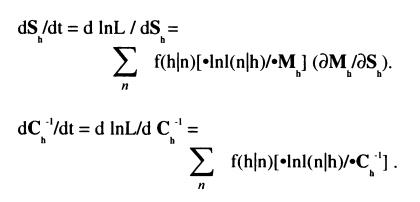
The same dynamic update only with different notation:

Thus on the basis of the current estimate for the parameters, the conditional probability a given observation x(t) being generated from state s is determined for each t = 1, …, m ; m being the sample size. The parameters are then updated such that the new component weights correspond to the average conditional probability and each component mean and covariance is the component specific weighted average of the mean and covariance of the entire sample.
Now we can use these new parameters and iteratively compute likelihood functions for each datapoint and model and compute new parameters...
Main problems which occured during implementation:
1, I know I should know how to multiply the matrices, but when you are in the n-dimensional space, have many different matrices, it can be quite tricky...
2, Covariance matrices - for each model there should be one (because you want to change parameters differently for each model), you can have scalar variance, isotropical model (having numbers only on the diagonal of the matrix) or full variance matrix - I recommend to start with isotropical and then continue to full variance matrix, and....covariance is standard deviation of the data
3, it isn't mentioned everywhere but you have to normalize everything what should be normalized
Ok, ok, but where is the Perlovsky's idea? I will surely describe it more precisely in some further post. But the main idea is to start from some highly fuzzy gaussian model, make it more and more crisp, then add some parameters, and fit the data as well as it is possible. So I'll discuss in the next posts some problems with adding models, changing parameters etc.
Further reading:
Nice explanations about Neural modeling fields, EM algorithm, Mixture models and gaussian probability function can be found on the Wikipedia.
About gaussian mixture models for example:
http://www.ll.mit.edu/mission/communications/ist/publications/0802_Reynolds_Biometrics-GMM.pdf
Very nice master thesis:
http://phd.arngren.com/DL/imm5217.pdf
Perlovsky's work:
book: Perlovsky, L.I. (2001). Neural Networks and Intellect: using model-based concepts. Oxford University Press, New York, NY (3PrdP printing).
some useful articles:
http://www.leonid-perlovsky.com/11%20-%20FDL%20NMNC.pdf
http://www.leonid-perlovsky.com/papers-online.html
pondělí 31. října 2011
Leonid Perlovsky
I´m now something like a platonic love with Leonid Perlovsky. It is full of news, full of surprises, disgust and also happiness from discovering new areas.
Let's introduce my story. From the beginning of my PhD.studies I have started to read a lot. After half a year I had read enough to know something but not enough to be good at something. Michal asked me to read and try to understand L.Perlovsky and his theory which he thought could be very interesting for him. He is playing with growing neural networks and some cognitive architectures. My task was to look deeper into the Neural field theory (which is the theory introduced by Leonid Perlovsky) and try to implement it.
After reading a lot of papers and also one book I started to understand at least a little what he is talking about. Or I thought I understand. That was totally new field for me, because I have never spent time with clustering, classification or other data mining methods before. So I was something like a blind man who is listening how does the world around look like. My view on his theory was a little bit strange because I didn't know relevant theories on which he is building his new approach. But let say that after few months I was able to work with it and I´ve even tried to implement the method in Matlab.
Until today I haven't been very successful, but I'm progressing. What is it all about and why I'm now a little bit sceptical?
The idea of this theory is that the bottom-up and top-down approaches are meating. Both data and model have some fuzziness and while it is approaching each other it is getting more and more crisp. Starting with some very fuzzy gaussian model it is starting to be more crisp when the fuzziness is getting smaller (he calls this dynamic fuzzy logic). The main idea is that when the error rate is starting to increase we will add new model and watch if there will be decrease in the errorness. When we find the best number of models we will try to change the parameters and approximate the data. So from the very fuzzy gaussian model with low number of parameters we are getting to the set of crisp parametrized models. With this approach Perlovsky is hoping to defeat the curse of dimensionality and the computational complexity which is so problematic in these clustering methods.
What was very strange and instructive for me was, when I read the book about feature selection computational methods and afterwards some dissertation thesis about Gaussian mixture models. What a surprise. This huge theory which was introduced for NASA is only Gaussian mixture model with fuzziness and nice biological and philosophical background. So nothing strange. But why he doesn't mention this? To confuse me as a novice in this area? It could be much easier to know all these things, because GMM are implemented and very well described. So I could only work on the improvements of the method and my task wouldn't be to start from the beginning and look for some relevant information in the big book full of philosophical and metaphysical thoughts.
So it is another advice for me before I start with some other thing.
Now I hope the work will continue much quicker having know all these things. Because I must admit that I'm quite fed up with searching and trying. Want some support in the results.
Let's introduce my story. From the beginning of my PhD.studies I have started to read a lot. After half a year I had read enough to know something but not enough to be good at something. Michal asked me to read and try to understand L.Perlovsky and his theory which he thought could be very interesting for him. He is playing with growing neural networks and some cognitive architectures. My task was to look deeper into the Neural field theory (which is the theory introduced by Leonid Perlovsky) and try to implement it.
After reading a lot of papers and also one book I started to understand at least a little what he is talking about. Or I thought I understand. That was totally new field for me, because I have never spent time with clustering, classification or other data mining methods before. So I was something like a blind man who is listening how does the world around look like. My view on his theory was a little bit strange because I didn't know relevant theories on which he is building his new approach. But let say that after few months I was able to work with it and I´ve even tried to implement the method in Matlab.
Until today I haven't been very successful, but I'm progressing. What is it all about and why I'm now a little bit sceptical?
The idea of this theory is that the bottom-up and top-down approaches are meating. Both data and model have some fuzziness and while it is approaching each other it is getting more and more crisp. Starting with some very fuzzy gaussian model it is starting to be more crisp when the fuzziness is getting smaller (he calls this dynamic fuzzy logic). The main idea is that when the error rate is starting to increase we will add new model and watch if there will be decrease in the errorness. When we find the best number of models we will try to change the parameters and approximate the data. So from the very fuzzy gaussian model with low number of parameters we are getting to the set of crisp parametrized models. With this approach Perlovsky is hoping to defeat the curse of dimensionality and the computational complexity which is so problematic in these clustering methods.
What was very strange and instructive for me was, when I read the book about feature selection computational methods and afterwards some dissertation thesis about Gaussian mixture models. What a surprise. This huge theory which was introduced for NASA is only Gaussian mixture model with fuzziness and nice biological and philosophical background. So nothing strange. But why he doesn't mention this? To confuse me as a novice in this area? It could be much easier to know all these things, because GMM are implemented and very well described. So I could only work on the improvements of the method and my task wouldn't be to start from the beginning and look for some relevant information in the big book full of philosophical and metaphysical thoughts.
So it is another advice for me before I start with some other thing.
Now I hope the work will continue much quicker having know all these things. Because I must admit that I'm quite fed up with searching and trying. Want some support in the results.
úterý 25. října 2011
Bio-inspired cognitive modeling or cognitive modeling?
Our lab haven't started yet and there was huge discussion about the name. Surely it is very important what will your name be. But what is interesting is that the discussion wasn't about the personal preferences but it went deeper.
We have discussed whether it is even possible to talk about cognitive modeling as bio-inspired cognitive modeling. Is cognition only functionalism phenomenon independent on the substrat or is it strictly biological phenomenon?
When we see it from the functionalism view then we focus on the functional ralations and it can be realized also in the robotics environment. Bio-inspired cognitive modeling is possible.
But there is also other point of view when we consider cognition as a strictly biological phenomenon. So it is allways related to the biological reality and bio-inspired cognitive modeling is nonsense (or at least repeated information). Because bio-inspiration could mean that we only construct some artificial system which isn't model in the real meaning - there is nothing to validate. From the model which isn't real system I can't also get inspiration how does the real biological system work.
Or does bioinspiration mean that we are constructing models which are trying to be nearly as complex and universal as the brain functioning is?
Does exist cognitive modeling which isn't bio-inspired? Something like we try to model cognition in the robot without any knowledge of the human brain? Is it still cognitive modeling?
So what will we be focused on?
What is bio-inspiration, cognition, intelligence? Too many words which have nearly lost their specific meaning and are nowdays used as something very fuzzy.
(this was mainly discussed by Matěj Hoffman and Michal Vavrečka)
We have searched the google and I have found also conference which name was "Bio-inspired modeling of cognitive tasks". So there are at least different interpretations. Or is it misused in this case?
Further Matěj mentioned the article from Barbara Webb: "Animals versus animats: or why not model the real iguana", where she compares artificial models and real animals or artificial systems exactly copying the biological systems.
So we decided to use as the name of the group something less controversial: Cognitive modeling and bio-inspired robotics.
Nice, nice, nice. Haven't started yet and so nice discussion. Looking forward:-).
We have discussed whether it is even possible to talk about cognitive modeling as bio-inspired cognitive modeling. Is cognition only functionalism phenomenon independent on the substrat or is it strictly biological phenomenon?
When we see it from the functionalism view then we focus on the functional ralations and it can be realized also in the robotics environment. Bio-inspired cognitive modeling is possible.
But there is also other point of view when we consider cognition as a strictly biological phenomenon. So it is allways related to the biological reality and bio-inspired cognitive modeling is nonsense (or at least repeated information). Because bio-inspiration could mean that we only construct some artificial system which isn't model in the real meaning - there is nothing to validate. From the model which isn't real system I can't also get inspiration how does the real biological system work.
Or does bioinspiration mean that we are constructing models which are trying to be nearly as complex and universal as the brain functioning is?
Does exist cognitive modeling which isn't bio-inspired? Something like we try to model cognition in the robot without any knowledge of the human brain? Is it still cognitive modeling?
So what will we be focused on?
What is bio-inspiration, cognition, intelligence? Too many words which have nearly lost their specific meaning and are nowdays used as something very fuzzy.
(this was mainly discussed by Matěj Hoffman and Michal Vavrečka)
We have searched the google and I have found also conference which name was "Bio-inspired modeling of cognitive tasks". So there are at least different interpretations. Or is it misused in this case?
Further Matěj mentioned the article from Barbara Webb: "Animals versus animats: or why not model the real iguana", where she compares artificial models and real animals or artificial systems exactly copying the biological systems.
So we decided to use as the name of the group something less controversial: Cognitive modeling and bio-inspired robotics.
Nice, nice, nice. Haven't started yet and so nice discussion. Looking forward:-).
Přihlásit se k odběru:
Příspěvky (Atom)