I have found the great step by step Python tutorial to PCA:
http://sebastianraschka.com/Articles/2014_pca_step_by_step.html
pondělí 8. června 2015

sobota 16. května 2015
Alison Gopnik TED talk and Bayesian babies
Alison Gopnik's TED talk about babies and what they are thinking about is simply awesome.
https://www.ted.com/talks/alison_gopnik_what_do_babies_think?language=cs#t-533681
Her presentation is clear and you won't be bored. It is also closely connected to my talk in the Neuroinformatics course. She pointed out that the length of the childhood is critical for the evolution of higher cognitive functions and smart behavior. Crowns who are very clever birds that can use sticks like a tool to get a food are dependent on their mother for nearly two years compared to chickens whose childhood last only for few months.
pátek 3. dubna 2015
Language development and disorderds - chart
I have found this very interesting chart on the blog: http://eceiler.blogspot.cz/2013/02/week-4-language-development-and-literacy.html?view=timeslide


This chart is from the book by Kuder: Teaching Students with Language and Communication Disabilities
úterý 25. listopadu 2014
Brain development - aging and newborns
How is brain changing during our lifes? What about its size, abilities, neurophysilogy? And what can we expect when getting older?
There is a huge increase in brain size during the prenatal period and a rapid neurogenesis (up to 250 000 new neurons/min). Cells are migrating and neurons are differentiating.
Weight of newborns' brain is 25% of adult brain, but the size of the brain is only few percent smaller. During this stage the breast feeding is important for neurons myelinization (myelin is important for transferring signal between neurons without lost) and crying and the response to it will enable newborns and the brain to learn the reaction to the stimuli. The process of myelinization is one of the most important during next few months and it is also the reason why the weight of brain is increased from 25% after birth to 75% of adult weight in 3 years. Myelinization is very important process and it durates from approx. 2 months to 5-10 years (in some areas it last longer - for example for prefrontal cortex it continues up to 10 years). Different brain arreas attain its peak cortical thickness in different time. Averaged thickness of cortex is the highest around 10 years of age.
During this stage synapses are also rapidly generated. In adulthood there are about 100mld neurons and each of them can have approximatelly 1000 synapses. Synaptogenesis in areas responsible for seeing/hearing lasts from prenatal period up to 5 years, on the other hand in areas responsible for higher cognitive functions synapses can be created up to approx 20 years. However experienced-dependent synapses can be created during whole life.

Fig. 1 Thompson RA, Nelson CA 2001 Developmental science and the media: Early brain development. American Psychologist 56(1):5-15
Have you ever heard that there are no new neurons after birth? It is actually not true. Neurogenesis in hippocampus (important part of brain for transforming memories from short-term memory to long-term memory) proceeds up to 30 years and maybe longer. On the other hand after birth neurons are overpopulated and lot of them must die (it is a controlled process).
Hm, weight of brain after birth is comparable for women and men but then the weight is more increased for men :-(.
And now what about aging? I am not speaking about any neurodegenerative diseases. I speak about normal aging. What is actually happening with the brain?
 Fig 2. (z webu: http://www.isagenixhealth.net/why-healthy-aging-starts-with-your-brain-webinar/)
The most important change is that cortex is getting thinner - primarily prefrontal cortex (planning, logical thinking etc.) and hippocampus (remembering). From the early adulthood the volume of the gray matter is lowered. This is very rapid in some areas while others seem to be nearly untouched until very high age (such as occipital lobe responsible for vision). White matter (composed of myelinated axons) is increased until 40 years and afterwards its volume is decreasing as well. Also some synapses are lost as well as plasticity (this is closely related to the usage of the brain). The reason for losing plasticity can be in problems with calcium regulation which is important for neural firing and transferring action potentials.
Morphology of neurons is also changed - they have smaller dendrites and their density and number of spins is 40% lower after 50 years compared to early adulthood. Whau thats a huge number, isn't it?
Another change - less number of neurotransmitters (dopamin, serotonin, glutamat...) which are important for communication among neurons. Also white matter is lost somewhere which I have mentioned above. Isn't it sad?
But it is not the end. Also aortas are thinner and less capillaries are created which changes blood supply to the brain (and less oxygen).
On the other hand the free radicals are accumulating (that are molecules which interacts easily with other molecules and are created during metabolism of mitochondrias when the oxygen is metabolised) which is called oxygenation stress. They can damage the cell membrane as well as DNA. This can be chain reaction (than it can cause Alzheimer disease).
And also DNA damages are accumulated.
Isn't it a sad story which is waiting for all of us? And I haven't mentioned several neurodegenerative diseases as Alzheimer, Parkinson, ALS etc.
Literatura
There is a huge increase in brain size during the prenatal period and a rapid neurogenesis (up to 250 000 new neurons/min). Cells are migrating and neurons are differentiating.
Weight of newborns' brain is 25% of adult brain, but the size of the brain is only few percent smaller. During this stage the breast feeding is important for neurons myelinization (myelin is important for transferring signal between neurons without lost) and crying and the response to it will enable newborns and the brain to learn the reaction to the stimuli. The process of myelinization is one of the most important during next few months and it is also the reason why the weight of brain is increased from 25% after birth to 75% of adult weight in 3 years. Myelinization is very important process and it durates from approx. 2 months to 5-10 years (in some areas it last longer - for example for prefrontal cortex it continues up to 10 years). Different brain arreas attain its peak cortical thickness in different time. Averaged thickness of cortex is the highest around 10 years of age.
During this stage synapses are also rapidly generated. In adulthood there are about 100mld neurons and each of them can have approximatelly 1000 synapses. Synaptogenesis in areas responsible for seeing/hearing lasts from prenatal period up to 5 years, on the other hand in areas responsible for higher cognitive functions synapses can be created up to approx 20 years. However experienced-dependent synapses can be created during whole life.

Fig. 1 Thompson RA, Nelson CA 2001 Developmental science and the media: Early brain development. American Psychologist 56(1):5-15
Have you ever heard that there are no new neurons after birth? It is actually not true. Neurogenesis in hippocampus (important part of brain for transforming memories from short-term memory to long-term memory) proceeds up to 30 years and maybe longer. On the other hand after birth neurons are overpopulated and lot of them must die (it is a controlled process).
Hm, weight of brain after birth is comparable for women and men but then the weight is more increased for men :-(.
And now what about aging? I am not speaking about any neurodegenerative diseases. I speak about normal aging. What is actually happening with the brain?
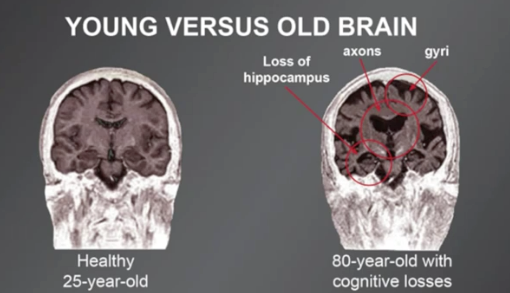
The most important change is that cortex is getting thinner - primarily prefrontal cortex (planning, logical thinking etc.) and hippocampus (remembering). From the early adulthood the volume of the gray matter is lowered. This is very rapid in some areas while others seem to be nearly untouched until very high age (such as occipital lobe responsible for vision). White matter (composed of myelinated axons) is increased until 40 years and afterwards its volume is decreasing as well. Also some synapses are lost as well as plasticity (this is closely related to the usage of the brain). The reason for losing plasticity can be in problems with calcium regulation which is important for neural firing and transferring action potentials.
Morphology of neurons is also changed - they have smaller dendrites and their density and number of spins is 40% lower after 50 years compared to early adulthood. Whau thats a huge number, isn't it?
Another change - less number of neurotransmitters (dopamin, serotonin, glutamat...) which are important for communication among neurons. Also white matter is lost somewhere which I have mentioned above. Isn't it sad?
But it is not the end. Also aortas are thinner and less capillaries are created which changes blood supply to the brain (and less oxygen).
On the other hand the free radicals are accumulating (that are molecules which interacts easily with other molecules and are created during metabolism of mitochondrias when the oxygen is metabolised) which is called oxygenation stress. They can damage the cell membrane as well as DNA. This can be chain reaction (than it can cause Alzheimer disease).
And also DNA damages are accumulated.
Isn't it a sad story which is waiting for all of us? And I haven't mentioned several neurodegenerative diseases as Alzheimer, Parkinson, ALS etc.
Literatura
- http://www.zerotothree.org/child-development/brain-development/
- Stiles J, Jernigan TL. The Basics of Brain Development. Neuropsychology Review 2010;20(4):327-348. doi:10.1007/s11065-010- http://www.ncbi.nlm.nih.gov/pmc/articles/PMC2989000/
- Thompson RA, Nelson CA 2001 Developmental science and the media: Early brain development. American Psychologist 56(1):5-15
- The changing brain in healthy aging http://www.nia.nih.gov/alzheimers/publication/part-1-basics-healthy-brain/changing-brain-healthy-aging
- Aging brain - wiki http://en.wikipedia.org/wiki/Aging_brain
- Human brain development timeline - wiki http://en.wikipedia.org/wiki/Human_brain_development_timeline
pondělí 10. listopadu 2014
Strabism and how big is the field of vision
During my presentation on university we have discussed the
strabism and how big is the field of vision for different types of strabism.


Fig. Strabism (Esotropia - the upper image, Exotropia - lower image)
Strabism is the disease when both eyes cannot simultaneously gaze
at the same fixation point. Therefore the image from both eyes cannot be
combined in a single image and this can cause so called "double
vision" = diplopia (Light from the visual input passess through lens to
the retina but to not corresponding places - from one eye it reaches the fovea but in the other eye not - therefore the subsequent fusion of
image is not possible). There are two main different kinds of strabism:
esotropia (axis of eyes intersect before fixation point) and exotropia (axes of
eyes intersect behing fixation point). Less frequent are hyper- and hypotropia
which correspond to the deviation in vertical line.

Fig. Esotropia and Exotropia
But what is the cause of strabism?
Strabism can be caused by different length of extraocular muscles
or by their lack of coordination. Secondly, strabism can be also caused by
problems with ocular nerves and subsequent problems with neural interpretation
of visual input (this is called lazy eye or amblyopia and brain will favor one of the eye and suppress the other). What I was not sure whether the strabism is somehow connected
to the problems with eye lens. My collegue told me that the problem is not
primarily caused by problems with lens but without any cure the problems with
eye lens can appear (caused by using only one eye etc.).
How can people with strabism see and work?
This is very interesting. When you use only one eye, you cannot
percieve the depth. When using both eyes they can perceive "double
vision" which can be quite dangerous in normal life: people with this
problem can fall from stairs or have problems with driving. Therefore they
frequently cover one of their eyes (especially the ill one which can cause
further problems which I will discuss beneath). The brain itself will supress
deviated eye in the central visual field where we have binocular vision.

Fig. Diplopia (double vision)
Do they have bigger/smaller field of
vision compared to healthy human?
You maybe know that the horizontal field of vision for normal
human is something as 200° (each eye about 160°, binocullar vision ~ 120°).
We could expect that people with exotropia should have bigger
field of vision than people with normal vision and similarly people with
esotropia should have this field of vision smaller. Anyway, this is not exactly
true. People with strabism have "bigger field of vision" when using
only one eye (the second eye is covered), but while brain cannot work with
"double vision", it accomodates and the central part of the field
(approximatelly 20° is excluded). Sometimes one eye is completly suppressed.
What is even more interesting is that when you completelly cover
one of your eyes (to improve your vision) and stop using it, the muscles which
are used for accomodation of lens will loose their strength and afterwards it
can also cause total "deth" of one of your eyes (also neural
connection are not working anymore).
And...how big is the field of vision for
birds?
Just interested, whether birds with bigger eyes (and lens) have
also bigger field of vision. And the answer is YES! Yes, they have. Something
as 300° compared to 200° which is the normal humens' field of vision. Furthermore
they can perceive even small changes in light intensity (owl), big distances,
binocularly and some birds see also colors.
OK! But how to cure strabism?
There are several methods. One of them is to cover the healthy eye
which will cause that the "ill" eye will have to work more. Other
methods are mainly focused on strengthening and training extraocular muscles. One
of my collegue is prepares set of games which can be used for diagnosing and curing
strabism: here (unfortunatelly just in Czech).
One problem with curing strabism can be that after cure, the brain is not able to supress the deviated eye in the area of binocular vision
and the patient can again perceive "double vision" (dyplopia).
středa 2. ledna 2013
Joomla webpages
After long time I have opened webpages of my FRVS project created in Joomla. I have faced few problems. This is not a tutorial, just few things which I found out I have forgotten after few months...
How to edit Joomla webpages on localhost?
open localhost\...\administrator (administrator instead of index.html or index.php)
How to add new article?
Add article into article manager
- add article within existing category and into menu item which is a list of Category articles (maybe necessary to add new Category in Category manager)
- or in Menu manager add new menu item (with single article content) and link to the created article
How to link to file?
- Upload file through Media manager
- Add link to text which will link to a file (icon Link in Article editor)-> Browse for a link and select a file you want to link to
How to add zip files to Joomla:
It is not default option. Go to Media manager->Options->add ZIP and zip into list of allowed extensions
How to upload Joomla webpages on web:
1. Upload your newly created Joomla site to the server via FTP.
2. Create the MySql Database.
3. Edit the configuration.php file and set the newly created server database name, username, password correctly. U don't have to change the host name usually its "localhost" but if your server MySql is belong to a different IP u need to put that ip in the hostname.
4. upload/replace the configuration.php file.
5. Export your Local Joomla(PC) database (e.g using PhpMyadmin) and import the same in your Server Database.
úterý 30. října 2012
Openness in Education
Today, I have been listening (on SIIE 2012 conference) to very interesting talk by Dr.Charles Severance from Michigan university who is a creator of Sakai project (a project similar to Moodle) for e-learning education.
Eventhough I'm not able to repeat his personality which is so vivid, enthusiastic and full of life, I can mention here few main ideas of the talk.
He was speaking about the history of academics and researchers. In medieval times there was a small group of academics, who were quite strange and the community was closed. They were donated by a small money from King or from important people in industry and backwards few of these academics become kings or wealthy industrialists. The ideas were coming up slowly by talking one to each other and by letting the knowledge inside the fortress of the university.
Later, mainly during the world war II, politicians spent a lot of money and donated academics, because they needed their knowledge and ideas to be the winners of the war. From this research also other things have been evolved like cars, space shuttles etc.
Afterwards during the last decades of the 20th century, government gave research money and wanted back solutions - like ARPANET. Ideas from academics also went to the outside world as ideas of networks or open source products.
Academics were still giving back something for the money they got. Today the results of academics are tons of journal papers and eventhough governments spent so much money on the research (because they think that it was always useful), they got quite little backwards. On the other site there are people in praxis, people who own big companies like Amazon, Google, Facebook...which are the ones who are the ones who pushes the knowledge forward, eventhough their idea isn't to solve problems and be curios about the nature of the world, but just to earn money.
Academics live their own closed life, publishing and trying to get enough money from government. The number of academicians has grown so quickly but the results aren't so surprising. They often discuss something what people in praxis have invited years before them and used it in their companies.
What can be the future? The first possibility is that governement will stop the money and the number of academicians will drop down quickly because they will have no fundation. It is natural, because when governement will see that the results from research aren't very useful and they got nothing which is applicable, they will stop giving money for these purposes. The research environment we have now is the result of the research of the people before 2000.
But we have a choice. We can open our ideas, cooperate with the real world and find fundation somewhere else than in governement. "new graduates have to compete all great companies in a world full of ideas instead of writing articles" Then we can work independently. We must have some direction of our research, not only to publish papers. And also, we should be openned to the whole world - create academical blog where we share our ideas, go between the people, be part of some open source community, real-world impact and tenure, create identity personality etc.
And Dr.Chuck is the one who made it happened. He got the fundation - enough money to make real cool ideas, he has his own academics blog: http://www.dr-chuck.com/csev-blog/ and his own webpages http://www.dr-chuck.com/, he leads on coursera.org the online course https://www.coursera.org/course/insidetheinternet, he is a director of Sakai project, he published many books, likes to drive motorcycle and communicate. When he saw openness in education in Stanford university, which is the first university where every course is openned to anybody who wants to participate, he thought that it could be perfect to have the same thing on Michigan university. When they said: not yet, he decided to create his own open "university" Dr.Chucks class2go. What does it mean? He says yes to things which appears infront of him. He isn't aware of the work and time he must spend on the project and he starts everything with enthusiasm. Not to be closed, be open to the whole world it is the only possiblity....
And on the end from the Joshua Kim review of his book "Chuck Severance is Crazy:When I say that Chuck Severance is crazy, I mean crazy in the very best possible way. Crazy as in completely honest. Crazy as in willing to say things that might offend other people. Crazy in the sense that he is willing to be critical of his own actions. Crazy in that he believes in the promise of open source software in higher education more than he cares about his own career advancement. Crazy in that he is willing to take risks, to fail, and to learn from his mistakes.I don't know Chuck Severance, but I hope that I get the chance. This is a guy who quit a series of good jobs in quick succession in order to have the opportunity to work on a risky open source education project."
I had the opportunity to see him and it was a great thing-if you will have that chance, don't miss it. What more - I had the opportunity to speak to him for a few seconds, to ask him a question and to be introduced to him. He is so full of energy that it seems to be impossible.
Přihlásit se k odběru:
Příspěvky (Atom)